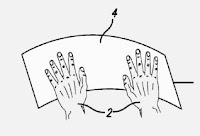
 Following the success of the iPhone and iTouch, a larger 'tablet' has been rumoured to provide a multi-touch interface to Apple's computer range. Indeed, Apple has submitted a patent for a sophisticated keyboard-sized touch interface. The Telegraph reports that the patent application, filed in June by Fingerworks, an Apple-owned company, shows two hands hovering over a flexible, screenlike device, which will offer "unprecedented integration of typing, resting, pointing, scrolling, 3D manipulation and handwriting into a versatile, ergonomic computer input device".
If the product is developed, another level of automation could be on its way. According to Apple, the multi-touch interface would be able to interpret gestures made by the whole hand or individual fingers, and also predict what the user might want to do – type, write or draw or launch programs, menus or interfaces. Source: Telegraph, 02 October, 2009. tinyurl.com/ydtdm6c
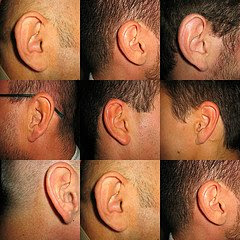 Italian researchers have found in three separate tests that people are better at processing information when requests were made to their right ear. They believe this is because the left side of the brain, which is better at processing requests, deals with information from the right ear. The findings are reported online in the journal Naturwissenschaften. In conclusion, the researchers said: "Talk into the right ear you send your words into a slightly more amenable part of the brain. These results seem to be consistent with the hypothesised specialisation of right and left hemispheres." Professor Sophie Scott, of the Institute of Cognitive Neuroscience at University College London, agreed, and noted "we can also see this tendency when people use the phone, most will naturally hold it to their right ear." The research may have implications for the presentation of auditory information. Source: BBC, 24 June 2009. tinyurl.com/ksu9onhttp://www.flickr.com/photos/banlon1964/ / CC BY-NC-ND 2.0
 An Emirates flight EK-407 from Melbourne to Dubai narrowly avoided disaster, with 275 people on the Airbus jet. On the flight deck, the first officer and the captain fed routine information, including the plane's weight and fuel load, into a computer. The procedure was for them to check each other's work to avoid mistakes. The first officer opened the throttles and headed down runway. As the first officer tried to ease the aircraft off the runway, the jet stayed grounded. On a second attempt, the nose came up — but the jet's rear repeatedly hit and dragged along runway, puncturing the skin of the jet, tearing off a panel and breaching the air pressurisation. Eventually, at the end of the runway, the jet began climbing. But it was still too low, hitting a runway light, then antenna equipment on the ground, and scraping the grass. With seconds to spare, the jet climbed and finally reached a safe height. The pilots dumped most of their fuel over the bay and, with smoke in the cabin, the plane was given emergency clearance to land. When the pilots checked their instruments they spotted the potentially fatal mistake. Before take-off, their fuelled-up jet weighed 362 tonnes. But they had accidentally keyed in 262 tonnes, resulting in too little engine power. Only the captain's rapid reactions averted a disaster. Source: Sydney Morning Herald, 01 May 2009. tinyurl.com/kjd3r2Image: http://www.flickr.com/photos/storm-crypt/ / CC BY-NC-ND 2.0
 Following the success of the iPhone and iTouch, a larger 'tablet' has been rumoured to provide a multi-touch interface to Apple's computer range. Indeed, Apple has submitted a patent for a sophisticated keyboard-sized touch interface. The Telegraph reports that the patent application, filed in June by Fingerworks, an Apple-owned company, shows two hands hovering over a flexible, screenlike device, which will offer "unprecedented integration of typing, resting, pointing, scrolling, 3D manipulation and handwriting into a versatile, ergonomic computer input device".


